
The Adapt Again System™
Evidence & Value
What changed and what remained?
Outcome evidence establishes what changed and what value resulted. Capability evidence investigates whether adaptive ability remained or increased. Neither should be inferred from activity alone.
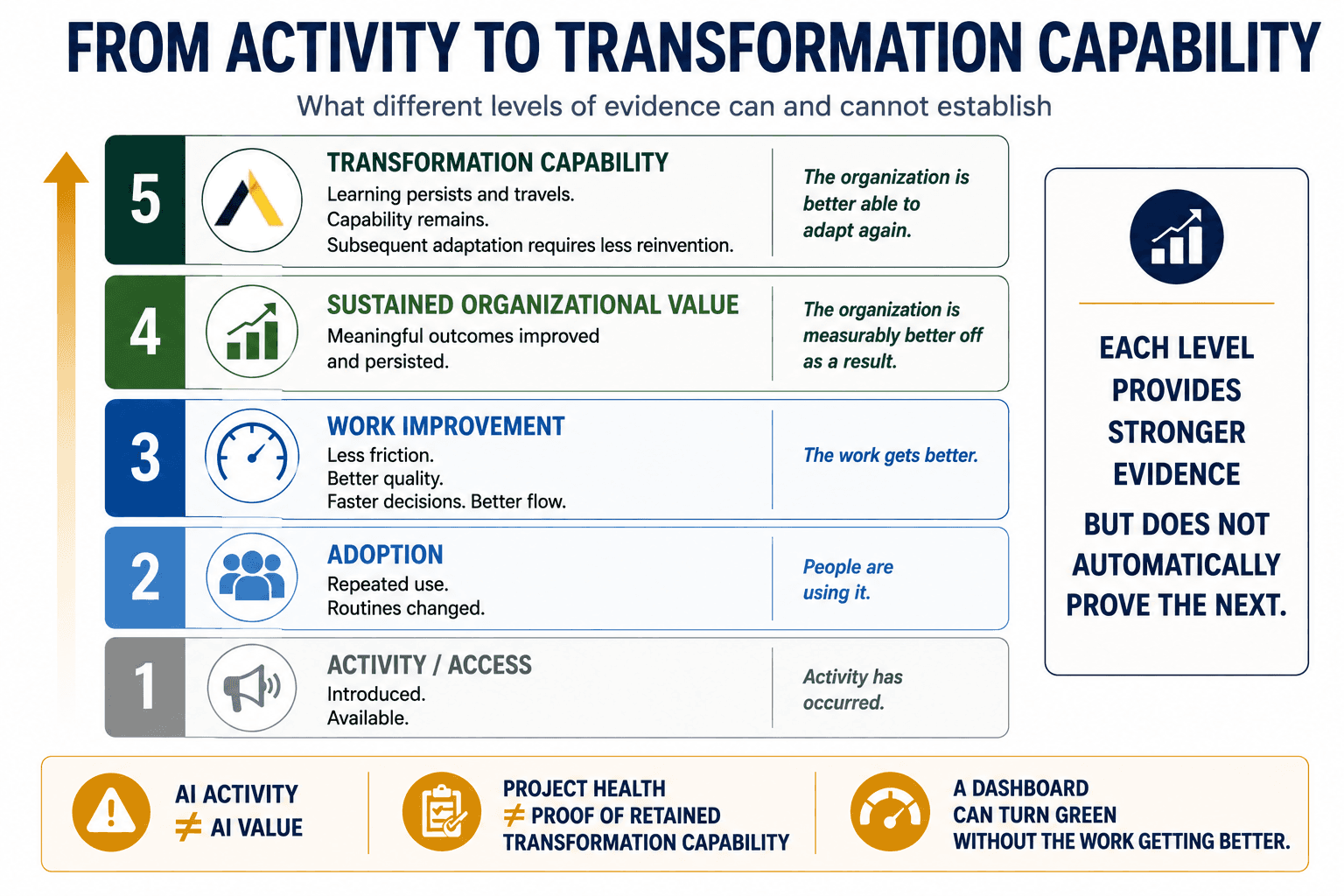
Five evidence levels
1. Activity / Access
Something was introduced or made available: pilots, licences, training, tools, workshops or new processes.
What this does not yet tell us: whether people use it, work improved, value was sustained, or capability remained
2. Adoption
People use it repeatedly in real work and routines begin to change.
What this does not yet tell us: whether the work actually improved or consequential value was created.
3. Work Improvement
Work became meaningfully better: less friction or rework, improved quality, faster decisions, better flow or reduced workload.
What this does not yet tell us: whether the improvement produced sustained organizational value or strengthened Transformation Capability.
4. Sustained Organizational Value
Customer, financial, risk, resilience, mission, workload or productivity outcomes improved and persisted.
What this does not yet tell us: whether the organization became better able to adapt again.
5. Transformation Capability
Learning persisted and travelled; meaningful ownership and competence remained; systems stayed revisable; subsequent adaptation required less reinvention.
What this does not yet tell us: whether the capability will persist over time and through future triggers. That can only be established by observing what happens over time.
The levels are not a score. Evidence can be uneven across teams and interfaces. High adoption can coexist with little work improvement. Strong local results can coexist with no organizational value.
How do we know Transformation Capability persists over time?
1. Persistence: Whether improvement and supporting ability survive reduced exceptional attention or support.
2. Transfer: Whether useful learning moves to another relevant context with meaning preserved, without assuming replication.
3. Ownership: Whether meaningful competence, accountability and authority remain rather than depending permanently on borrowed capability.
4. Renewal: Whether embedded practices and governance can be challenged and revised as conditions change.
5. Adapt Again: Whether the organization responds to the next meaningful trigger with less reinvention, unnecessary disruption or extraordinary intervention.
From evidence to application
The framework shows what evidence matters and how Transformation Capability can be recognized. Applying it within an organization means examining where value is being created, where learning or change is getting stuck, and what needs to change in the surrounding system to turn local progress into sustained organizational value and greater ability to adapt again.
Apply Adapt Again in your organization
Continue Exploring